
Detailed Summary of Recommendations from the 55th GST Council Meeting
Services
Business Incorporation & Compliance
Registration & Certification Services
GST Advisory & Compliance
Income Tax Advisory & Compliance
Accounting and Payroll Services
Audit & Assurance Services
International Tax Services
UAE Business Services
Financial Insights
Date: 21st December 2024
Venue: Jaisalmer, Rajasthan
Chairperson: Union Minister for Finance & Corporate Affairs Smt. Nirmala Sitharaman
Attendees: Union Minister of State for Finance Shri Pankaj Chaudhary, Chief Ministers of Goa, Haryana, Jammu and Kashmir, Meghalaya and Odisha, Deputy Chief Ministers of Arunachal Pradesh, Bihar, Madhya Pradesh and Telangana, Finance Ministers of States & UTs (with legislature), and senior officers of the Ministry of Finance & States/UTs.
The 55th meeting of the GST Council was held on 21 December 2024 in Jaisalmer, Rajasthan under the chairpersonship of Union Finance & Corporate Affairs Minister Smt. Nirmala Sitharaman. The Council recommended changes to GST rates, relief for individuals, trade facilitation measures and steps to streamline compliance. Major outcomes include the clarification that vouchers are not taxable, a lower pre-deposit for penalty-only appeals, and a legal framework for the Invoice Management System (IMS). The key recommendations are summarised below.
Key Recommendations by GST Council
- Changes in GST Rates on Goods:
- Fortified Rice Kernel (FRK) (heading 1904): GST reduced to 5%.
- Gene therapy: Fully exempt from GST.
- Food for welfare schemes: The concessional 5% rate extended to food inputs (HSN 19 or 21) supplied for food preparations distributed free to economically weaker sections under government programmes.
- Merchant exporters: Compensation cess on supplies to merchant exporters reduced to 0.1%, in line with the GST rate on such supplies.
- Defence and IAEA: IGST exemption extended to systems, parts and equipment for the LRSAM system. Imports of equipment and consumable samples by IAEA inspection teams exempted, subject to conditions.
- Changes in GST on Services:
- Sponsorship services provided by body corporates moved from reverse charge to forward charge.
- Motor Vehicle Accident Fund: Contributions by general insurers from third-party motor premiums to the fund under section 164B of the Motor Vehicles Act exempted. The fund compensates and provides cashless treatment to road accident victims, including hit-and-run cases.
- Restaurants in hotels: “Declared tariff” removed. From 1 April 2025, the rate on restaurant services in a hotel depends on the actual value of accommodation supplied in the preceding financial year: 18% with ITC if any unit exceeded ₹7,500 per day, otherwise 5% without ITC. Hotels may also opt for 18% with ITC by declaration.
- Commercial rent under RCM: Composition taxpayers excluded from reverse charge on renting of commercial property by unregistered persons (Notification 09/2024-CTR). The period from 10.10.2024 is regularised on an “as is where is” basis.
- Clarifications on Goods and Services:
- Old and used vehicles: GST on sale of all old and used vehicles, including EVs, increased from 12% to 18% (other than those already at 18%). GST applies only on the supplier’s margin (selling price minus purchase price or depreciated value), not on the full vehicle value, and does not apply to unregistered persons.
- AAC blocks with more than 50% fly ash: HS 6815, 12% GST.
- Pepper and raisins (fresh green or dried pepper) supplied by an agriculturist: not liable to GST.
- “Pre-packaged and labelled” redefined to cover all commodities for retail sale of up to 25 kg or 25 litres that are “pre-packed” under the Legal Metrology Act, or required to carry its declarations.
- Popcorn: Ready-to-eat popcorn with salt and spices is 5% if not pre-packaged and labelled, and 12% if pre-packaged and labelled. Caramel popcorn (mixed with sugar) is sugar confectionery at 18%. This is a clarification, not a new tax, and past issues are regularised.
- Payment aggregators regulated by RBI qualify for the exemption for “acquiring banks”. Payment gateways and fintech services not involving settlement of funds do not.
- Penal charges collected by banks and NBFCs for non-compliance with loan terms: no GST.
- Vouchers: Not a Supply:
- Sections 12(4) and 13(4) of the CGST Act and rule 32(6) to be omitted.
- Transactions in vouchers are neither supply of goods nor supply of services.
- Distribution of vouchers on a principal-to-principal basis is not subject to GST. On a principal-to-agent basis, the agent’s commission is taxable.
- Related services such as advertisement, co-branding, marketing, customisation and customer support are taxable.
- Unredeemed vouchers (breakage) are not a supply, so no GST on breakage income.
- Trade Facilitation Measures:
- SEZ/FTWZ warehoused goods: Supply of goods warehoused in an SEZ or FTWZ before clearance for export or to the DTA is neither a supply of goods nor services (Schedule III, para 8(aa), w.e.f. 01.07.2017), at par with customs bonded warehouses.
- E-commerce operators: No proportional ITC reversal required for supplies on which the ECO pays tax under section 9(5).
- Ex-works contracts: Where goods are handed over at the supplier’s premises and title passes there, the recipient is treated as having “received” the goods and can claim ITC under section 16(2)(b), subject to sections 16 and 17.
- GSTR-9C late fee: Late fee under section 47(2) applies to the complete annual return (GSTR-9 and GSTR-9C). For 2017-18 to 2022-23, late fee for delayed GSTR-9C in excess of that payable up to the GSTR-9 filing date is waived, if GSTR-9C is filed by 31 March 2025.
- Streamlining Compliance:
- Track and Trace: New section 148A to empower the Government to enforce a track and trace mechanism, based on unique identification marking, for specified evasion-prone goods.
- Online services to unregistered recipients (online gaming, OIDAR, etc.): The State of the recipient must be recorded on the invoice and is treated as the recipient’s address for place of supply.
- Amendments in Law and Procedure:
- Pre-deposit for penalty-only appeals reduced from 25% to 10% before the Appellate Authority, with a 10% pre-deposit also before the Appellate Tribunal.
- Section 17(5)(d): “plant or machinery” to be replaced with “plant and machinery”, retrospectively from 01.07.2017.
- ISD for inter-State RCM: The Input Service Distributor mechanism explicitly covers inter-State reverse charge supplies, effective 01.04.2025.
- Temporary Identification Number: New rule 16A for persons not liable to register but required to make a payment.
- Composition taxpayers can modify their “category of registered person” through FORM GST REG-14.
- Invoice Management System (IMS): Legal framework for generating GSTR-2B based on actions in IMS. Recipients must reverse ITC attributable to credit notes (section 34(2)), and a new rule 67B covers adjusting the supplier’s liability. GSTR-3B can be filed only after GSTR-2B for that period is available.
- Other Decisions:
- IGST settlement issues raised by States to be resolved by March 2025.
- GSTAT procedural rules noted, for notification after examination by the Law Committee.
- Group of Ministers on GST compensation restructuring given time till 30 June 2025.
- A new Group of Ministers to recommend a uniform policy on levies during natural disasters.
- GST on FSI charges collected by municipalities was deferred for further examination.
What This Means for Businesses
- Companies issuing or distributing gift vouchers and prepaid instruments should revisit their GST position on voucher sales, distribution and breakage.
- Banks and NBFCs can stop charging GST on penal charges in line with the clarification.
- Used-car dealers should note the 18% rate applies only to the margin.
- Taxpayers should align their ITC process with IMS, especially for credit notes.
Note: These are recommendations of the GST Council as announced. They are given effect through the relevant circulars, notifications and law amendments, which alone have the force of law. Several of these rates were later revised under the GST 2.0 rate structure from 22 September 2025 (see our article on the 56th GST Council meeting). Source: Press Information Bureau, Ministry of Finance, release dated 21 December 2024 (Release ID 2086873).
Read More Insights
Detailed Summary of Recommendations from the 56th GST Council Meeting (GST 2.0)
56th GST Council meeting (3 Sep 2025): new 5% and 18% rate structure, 40% de-merit rate, insurance exempted, key rate cuts, 90% provisional refunds and GSTAT timelines.
Standard Chartered Bank vs. The Principal Commissioner Of Central Tax & Others – Telangana High Court Judgment (11 July 2024)
Standard Chartered Bank vs. The Principal Commissioner Of Central Tax & Others – Telangana High Court Judgment (11 July 2024) Home Insights Standard Chartered Bank
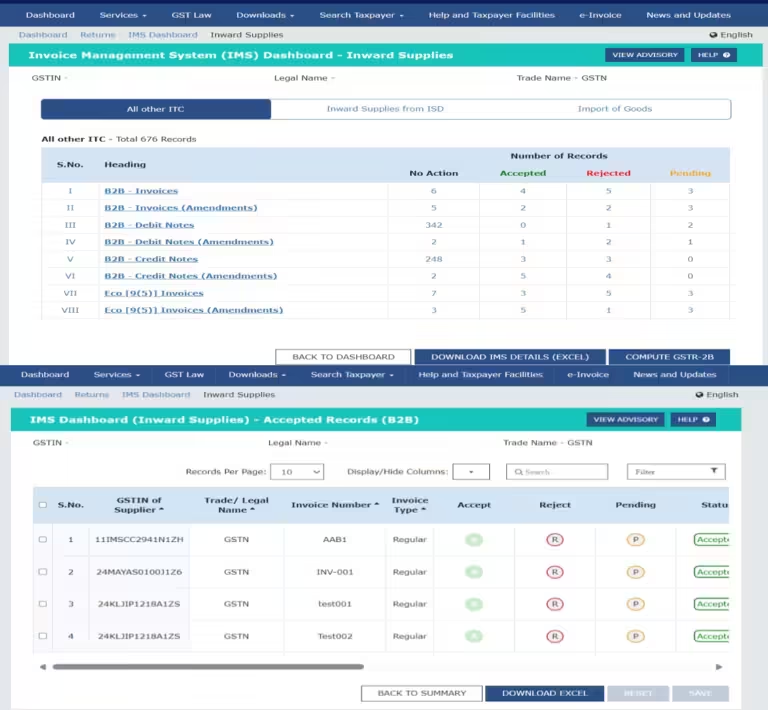
Invoice Management System (IMS) for Efficient GST Input Tax Credit (ITC) Management
Invoice Management System (IMS) for Efficient GST Input Tax Credit (ITC) Management Home Insights Invoice Management System (IMS) for Efficient GST Input Tax Credit (ITC)