
Detailed Summary of Recommendations from the 56th GST Council Meeting (GST 2.0)
Services
Business Incorporation & Compliance
Registration & Certification Services
GST Advisory & Compliance
Income Tax Advisory & Compliance
Accounting and Payroll Services
Audit & Assurance Services
International Tax Services
UAE Business Services
Financial Insights
Detailed Summary of CBIC Instruction No. 03/2025-GST
Union Budget 2025: Direct Tax Comprehensive Overview
Date: 3rd September 2025
Venue: New Delhi
Chairperson: Union Minister for Finance & Corporate Affairs Smt. Nirmala Sitharaman
The 56th meeting of the GST Council was held on 3 September 2025 in New Delhi under the chairpersonship of Union Finance & Corporate Affairs Minister Smt. Nirmala Sitharaman. It approved the “Next-Generation GST Reforms” announced on 15 August 2025, often called GST 2.0. The four-slab structure was replaced with two main rates, rates were cut on a wide range of everyday goods and services, and individual life and health insurance were exempted. The new rates took effect from 22 September 2025. The key recommendations are summarised below.
Key Recommendations by GST Council
- New Two-Rate Structure:
- Standard rate of 18% and merit rate of 5% replace the earlier 5%, 12%, 18% and 28% slabs for most goods and services.
- A special de-merit rate of 40% applies to a select few goods and services, such as specified luxury and sin goods, casinos, betting, gambling, horse racing, lottery and online money gaming, and admission to sporting events like the IPL.
- Effective Date and Phasing:
- Revised rates on services and on all goods except tobacco products apply from 22 September 2025.
- Pan masala, gutkha, cigarettes, chewing tobacco (such as zarda), unmanufactured tobacco and bidi continue at existing GST and compensation cess rates until the loans and interest under the compensation cess account are fully repaid. The Union Finance Minister will decide the transition date.
- GST on pan masala, gutkha, cigarettes and tobacco products will be levied on Retail Sale Price (RSP) instead of transaction value.
- Insurance Exempted:
- All individual life insurance policies (term, ULIP and endowment) and their reinsurance: exempt (earlier 18%).
- All individual health insurance policies, including family floater and senior citizen policies, and their reinsurance: exempt (earlier 18%).
- Rate Reductions on Goods (Key Items):
- Daily-use items: Hair oil, toilet soap bars, shampoos, toothbrushes, toothpaste, bicycles, tableware, kitchenware and other household articles reduced from 18% or 12% to 5%.
- Food: UHT milk, pre-packaged and labelled chena/paneer, and all Indian breads (chapati, roti, paratha, parotta, etc.) reduced to NIL. Packaged namkeens, bhujia, sauces, pasta, instant noodles, chocolates, coffee, preserved meat, cornflakes, butter, ghee and most other food items reduced from 12% or 18% to 5%.
- Consumer durables and vehicles: Air-conditioners, all TVs, dishwashers, small cars, motorcycles up to 350 cc, three-wheelers, and buses, trucks and ambulances reduced from 28% to 18%. All auto parts at a uniform 18%.
- Cement: Reduced from 28% to 18%.
- Health: 33 lifesaving drugs reduced from 12% to NIL, and 3 drugs for cancer, rare and chronic diseases from 5% to NIL. All other medicines reduced from 12% to 5%. Medical, surgical, dental and veterinary apparatus reduced from 18% to 5%. Bandages, gauze, diagnostic kits and glucometers reduced from 12% to 5%.
- Agriculture: Tractors and agricultural, horticultural and forestry machinery (for soil preparation, harvesting, threshing, balers, mowers and composting machines) reduced from 12% to 5%.
- Labour-intensive sectors: Handicrafts, marble and travertine blocks, granite blocks and intermediate leather goods reduced from 12% to 5%.
- Inverted duty structure corrected: Man-made fibre reduced from 18% to 5%, man-made yarn from 12% to 5%, and sulphuric acid, nitric acid and ammonia (fertiliser inputs) from 18% to 5%.
- Renewable energy: Devices and parts for their manufacture reduced from 12% to 5%.
- Rate Changes on Services (Key Items):
- Hotel accommodation up to ₹7,500 per unit per day: 12% with ITC to 5% without ITC.
- Beauty and physical well-being services (gyms, salons, barbers, yoga centres, etc.): 18% with ITC to 5% without ITC.
- Transport: Goods transport by GTA stays at 5% without ITC, and the 12%-with-ITC option becomes 18% with ITC. Passenger transport by motor vehicle and passenger vehicle rental with operator (fuel included) stay at 5% with ITC of input services in the same line of business, and the 12% option becomes 18% with ITC. Goods carriage rental with operator: 12% to 5% (with limited ITC) or 18%. Multimodal transport (no air leg): 12% to 5% with restricted ITC, or 18%. Air travel in other than economy class: 12% to 18%.
- Job work: Job work for umbrellas, printing (Chapters 48/49), bricks, pharmaceuticals, and hides, skins and leather reduced from 12% to 5%. Residual job work increased from 12% to 18%.
- Others reduced from 12% to 5%: Third-party insurance of goods carriages, cinema tickets up to ₹100, common effluent treatment plants, and bio-medical waste treatment.
- Increased to 18%: Certain works contracts (offshore oil and gas, earthwork-heavy government contracts and related sub-contracts) and services relating to petroleum and gas exploration (from 12%).
- Restaurants: A stand-alone restaurant cannot declare itself a “specified premises” to pay 18% with ITC.
- Faster Refunds:
- 90% provisional refund for exports: Rule 91(2) amended so 90% of refunds on zero-rated supplies are sanctioned provisionally based on system risk evaluation, operational from 1 November 2025.
- 90% provisional refund for inverted duty structure: Section 54(6) to be amended. Meanwhile, CBIC was directed to grant such refunds administratively from 1 November 2025.
- Low-value exports: The minimum threshold for refunds on exports with payment of tax removed (section 54(14)). This helps small exporters shipping by courier or post.
- Simpler Registration:
- Automatic registration within 3 working days for low-risk applicants and those whose output tax on supplies to registered persons will not exceed ₹2.5 lakh per month. Expected to benefit about 96% of new applicants. Operational from 1 November 2025 (now rule 14A).
- In-principle approval for simplified registration for small sellers supplying through e-commerce operators across multiple States (taken forward in the 57th meeting as rule 14B).
- Other Trade Facilitation Measures:
- Intermediary services: Section 13(8)(b) of the IGST Act to be omitted, so place of supply becomes the location of the recipient. Indian intermediaries serving foreign clients can then claim export benefits.
- Post-sale discounts: The requirement for a pre-agreed discount linked to specific invoices (section 15(3)(b)(i)) to be removed. Discounts will be given through GST credit notes under section 34, with ITC reversal by the recipient. Circular 212/6/2024-GST rescinded, and a new circular to clarify financial/commercial credit notes and dealer discounts.
- GST Appellate Tribunal (GSTAT):
- GSTAT to start accepting appeals before the end of September 2025 and hearings before the end of December 2025.
- 30 June 2026 recommended as the time limit for filing backlog appeals.
- The Principal Bench will also act as the National Appellate Authority for Advance Ruling.
What This Means for Businesses
- Check that your HSN/SAC-wise rates in billing software, price lists and contracts reflect the rates in force from 22 September 2025.
- Hotels (up to ₹7,500), salons and gyms moving to 5% without ITC should review ITC reversal on common inputs and capital goods.
- Manufacturers in textiles, fertilisers and other inverted-duty sectors should reassess their refund position under the corrected rates.
- Exporters and intermediaries should plan for 90% provisional refunds and the new place-of-supply rule.
Note: These are recommendations of the GST Council as announced. They are given effect through the relevant circulars, notifications and law amendments, which alone have the force of law. Item-wise rates should be checked against the rate notifications (Notification No. 09/2025-Central Tax (Rate) dated 17.09.2025 and related notifications). Source: Press Information Bureau, Ministry of Finance, release dated 3 September 2025 (Release ID 2163555).
Read More Insights
Detailed Summary of Recommendations from the 55th GST Council Meeting
55th GST Council meeting (21 Dec 2024, Jaisalmer): vouchers not taxable, used vehicles at 18% on margin, no GST on penal charges, 10% pre-deposit for penalty appeals, IMS.
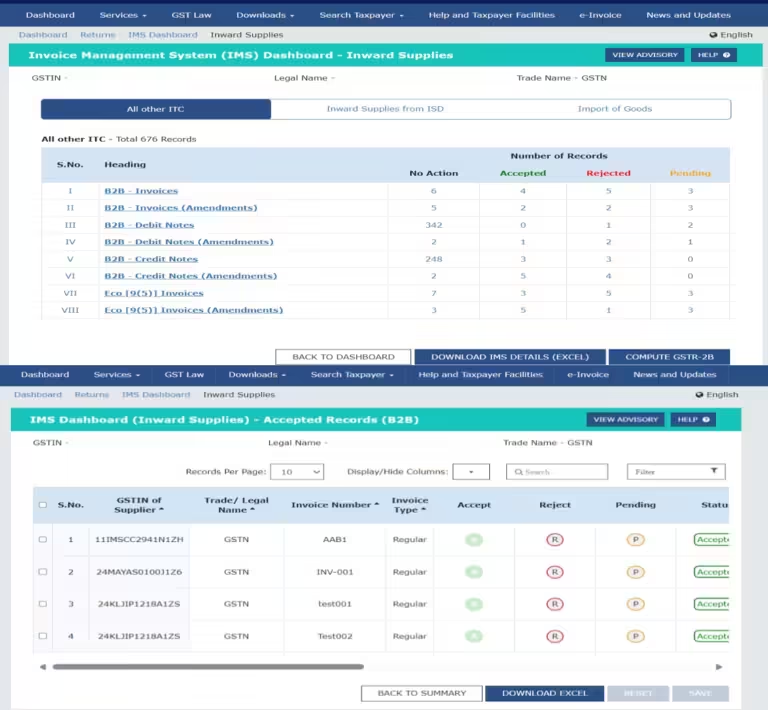
Invoice Management System (IMS) for Efficient GST Input Tax Credit (ITC) Management
Invoice Management System (IMS) for Efficient GST Input Tax Credit (ITC) Management Home Insights Invoice Management System (IMS) for Efficient GST Input Tax Credit (ITC)

Manappuram Finance Ltd. vs. Union of India & Ors. – Kerala High Court (29th July 2024)
Manappuram Finance Ltd. vs. Union of India & Ors. – Kerala High Court (29th July 2024) Home Insights Manappuram Finance Ltd. vs. Union of India