
MDR on UPI Payments from 15 October 2026: Rates, Exemptions and Tax Impact
Services
Business Incorporation & Compliance
Registration & Certification Services
GST Advisory & Compliance
Income Tax Advisory & Compliance
Accounting and Payroll Services
Audit & Assurance Services
International Tax Services
UAE Business Services
Financial Insights
Effective from: 15th October 2026
Legal basis: Notification dated 14th September 2026 under section 10A of the Payment and Settlement Systems Act, 2007 (as amended by the Taxation and Other Laws (Amendment) Act, 2026)
Issued by: Department of Financial Services, Ministry of Finance (FAQs dated 15th September 2026)
Rates decided by: UPI and Services Steering Committee, headed by NPCI
Since January 2020, merchants in India could accept UPI and RuPay debit card payments with zero Merchant Discount Rate (MDR). That changes from 15 October 2026. A 0.4% MDR will apply to UPI Person-to-Merchant (P2M) payments above ₹2,000, capped at ₹300 per transaction. Flat or lower rates apply for essential sectors and capital markets. Consumers, person-to-person transfers, small merchants and payments up to ₹2,000 stay free. This article explains the new rules, who is affected, and the GST and income tax points merchants should keep in mind.
Key Points of the New UPI MDR Framework
- What is MDR (Merchant Discount Rate)?
- MDR is the fee a merchant pays to its acquiring bank or payment aggregator for accepting digital payments. It is a percentage of the transaction value or a flat amount per transaction, and it is shared among the banks, payment service providers and the network that process the payment.
- The customer does not pay MDR. It is deducted from, or billed against, the amount settled to the merchant.
- For comparison, credit card MDR typically ranges from 1.5% to 2.5%, and debit card MDR is capped at up to 0.90% (as stated in the Ministry of Finance FAQs).
- Since 1 January 2020, payments through RuPay debit cards and UPI (BHIM-UPI / UPI QR code) carried zero MDR under section 10A of the Payment and Settlement Systems Act, 2007, read with section 269SU of the Income-tax Act, 1961.
- What Has Changed in the Law:
- Section 10A amended: The Taxation and Other Laws (Amendment) Act, 2026 amended section 10A of the Payment and Settlement Systems Act, 2007. Instead of covering all modes prescribed under section 269SU, it now protects only the electronic payment modes that the Central Government specifies by notification.
- Notification dated 14 September 2026: The Ministry of Finance notified that no bank or system provider may impose any charge, directly or indirectly, on a person making or receiving a payment through:
- RuPay debit cards, with no limit on amount; and
- UPI transactions up to ₹2,000.
- Who sets the rates: The MDR rates, category caps and fee distribution are decided by the UPI and Services Steering Committee, headed by NPCI. They are explained in the Ministry of Finance FAQs dated 15 September 2026.
- Effective date: 15 October 2026.
- New MDR Rates on UPI Merchant (P2M) Payments:
How MDR is calculated (examples from the Ministry of Finance FAQs):Category of merchant / payment Up to ₹2,000 Above ₹2,000 General merchant payments (P2M) Nil 0.4%, capped at ₹300 per transaction for payments of ₹75,000 and above Railways, telecom, insurance premium, fuel, public utilities (electricity, water, piped gas) and other notified “industry program” categories Nil Flat ₹5 per transaction Education fees (schools, universities, entrance examinations) Nil Flat fee or capped rate under the industry program category Capital market payments (mutual funds, SEBI-registered stockbrokers, securities dealers, investment platforms) Nil 0.02%, maximum ₹300
Note that once a payment exceeds ₹2,000, MDR is calculated on the full transaction value, not only on the amount above ₹2,000.Amount paid to merchant Applicable MDR MDR paid by merchant ₹2,000 Nil ₹0 ₹3,000 0.40% ₹12 ₹50,000 0.40% ₹200 ₹1,00,000 Cap applies ₹300 (not ₹400) - Who Is Not Affected:
- Consumers: No charge for paying through UPI. UPI apps cannot charge any platform fee on UPI payments.
- Person-to-person (P2P) transfers: Free for any amount, including transfers to family and friends and self-transfers between your own accounts.
- Small merchants (P2PM category): Vendors receiving up to ₹1 lakh per month through UPI QR directly into their own bank accounts continue with zero MDR, even on individual payments above ₹2,000. GST registration is not needed for this. A P2PM merchant whose UPI receipts exceed ₹1 lakh per month for 3 consecutive months is moved to the regular P2M category.
- UPI AutoPay / mandates: Recurring payments such as utility bills, OTT subscriptions and mutual fund SIPs carry no prescribed MDR.
- RuPay debit card payments: Remain free of charges, with no amount limit.
- Existing QR codes and soundboxes continue to work, with no need to replace or re-register them.
- Credit on UPI: Payments using RuPay credit cards linked to UPI or pre-sanctioned credit lines are outside this framework and continue under credit product rules.
- Rules Merchants Must Follow:
- No passing on to customers: Merchants cannot add a “UPI charge”, surcharge or convenience fee to recover MDR. Customers must pay only the displayed price.
- Who collects MDR: MDR is charged by the merchant’s acquiring bank or payment aggregator, as per the merchant agreement.
- Classification matters: Whether MDR applies depends on how the merchant account is categorised (P2PM or P2M, and the merchant category). Merchants should confirm their category with their bank or payment aggregator.
- Dedicated Fund for Small Merchants:
- A dedicated fund will support digital payment infrastructure in Tier 3 to 6 centres, including the North-Eastern States, J&K and Ladakh. In Tier 1 and 2 centres it covers merchants under notified Central Government schemes such as PM SVANidhi and PM Vishwakarma.
- It will give financial assistance to acquiring banks and payment aggregators for merchant onboarding, and incentives for UPI transactions from small merchants.
- The detailed framework is to be finalised in consultation with the RBI within three months.
- GST and Income Tax Implications for Merchants:
- GST on your sales is unchanged: GST is payable on the full value of supply charged to the customer. MDR is a separate expense and does not reduce the taxable value of your sales.
- GST on MDR: MDR is consideration for services provided by the acquiring bank or payment aggregator. Such financial services are generally taxable at 18%, and the FAQs do not mention any exemption. Registered merchants should check the tax invoices issued by their bank or payment aggregator and claim input tax credit, which must reflect in GSTR-2B/IMS.
- Income tax: MDR is a business expenditure, allowable like other bank and payment processing charges. Record it separately, for example as “payment gateway / MDR charges”, rather than netting it against sales.
- Reconciliation: Settlements will be received net of MDR (and GST on MDR). Reconcile daily or monthly settlements with your sales register and bank statements so that sales are not under-reported.
- Large businesses: The obligation for businesses above the prescribed turnover (₹50 crore) to provide prescribed electronic modes of payment continues under section 187 of the Income-tax Act, 2025 (earlier section 269SU), with a penalty of ₹5,000 per day for failure.
- Current Status (as of 10 October 2026):
- A writ petition has been filed in the Supreme Court challenging the notifications of 14 and 15 September 2026.
- Media reports in early October 2026 suggest the Government and NPCI are considering deferring the rollout to January 2027, and possibly exempting smaller businesses. No official decision has been announced so far. Unless officially changed, 15 October 2026 remains the effective date.
- We will update this article if the date or the rates change.
What This Means for Businesses
- Check your merchant category (P2PM or P2M, and any special category such as fuel, insurance or education) with your bank or payment aggregator before 15 October 2026.
- Review pricing and margins on high-value sales above ₹2,000. On a ₹10,000 sale, MDR is ₹40 plus GST.
- Do not add surcharges for UPI payments. This is not permitted.
- Remember RuPay debit cards remain free of MDR with no limit.
- Update your accounting to book MDR and GST on MDR separately, claim eligible ITC, and reconcile net settlements with sales.
Note: This article is based on the Ministry of Finance (Department of Financial Services) FAQs on “Merchant Discount Rate (MDR) on Select UPI (P2M) Transactions” dated 15 September 2026 and the notification dated 14 September 2026 under section 10A of the Payment and Settlement Systems Act, 2007. The GST and income tax points are our general professional view and not a substitute for advice on specific facts. Rates and dates may change; please refer to official updates from the Ministry of Finance, RBI and NPCI.
Read More Insights

Detailed Summary of CBIC Instruction No. 03/2025-GST
Guidelines for Streamlined Processing of GST Registration Applications – Issued on 17th April 2025 by the GST Policy Wing, CBIC Home Insights Guidelines for Streamlined
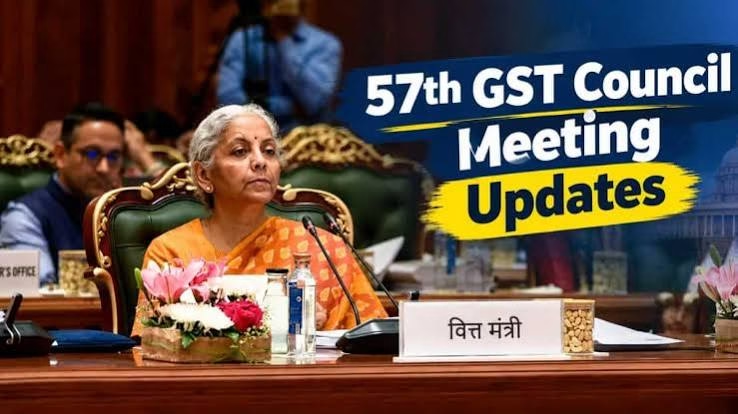
Detailed Summary of Recommendations from the 57th GST Council Meeting
57th GST Council meeting (8 Oct 2026): arrest powers removed, prosecution limit ₹5 crore, ₹10,000 notice threshold, automated refunds, wider ITC and registration reforms.
Air Transport Corporation (Assam) Pvt. Ltd. vs. State of U.P. & 3 Others – Allahabad High Court (5 January, 2018)
Air Transport Corporation (Assam) Pvt. Ltd. vs. State of U.P. & 3 Others – Allahabad High Court (5 January, 2018) Home Insights Air Transport Corporation