
Tax Saving and Tax Planning Tips for Individuals and HUFs under the Income-tax Act, 2025
Services
Business Incorporation & Compliance
Registration & Certification Services
GST Advisory & Compliance
Income Tax Advisory & Compliance
Accounting and Payroll Services
Audit & Assurance Services
International Tax Services
UAE Business Services
Financial Insights
Applies to: Tax year 2026-27 (1st April 2026 to 31st March 2027) onwards
Law: Income-tax Act, 2025 (in force from 1st April 2026)
Default regime: New tax regime (section 202)
For: Individuals and Hindu Undivided Families (HUFs)
With the Income-tax Act, 2025 now in force, many familiar provisions have new section numbers, and the new tax regime with zero tax up to ₹12 lakh has changed how individuals should plan their taxes. Smart tax planning today is less about buying tax-saving products in March. It is more about choosing the right regime, structuring salary well, planning capital gains, and using family members and HUFs within the law. Here are practical tax saving and tax planning tips for individuals and HUFs for tax year 2026-27.
Tax Planning Tips for Tax Year 2026-27
- Tax Planning vs Tax Saving: Start Early
- Tax planning means arranging your income, investments and expenses within the law to reduce tax. It is different from tax evasion. Every tip below uses provisions of the Income-tax Act, 2025.
- Plan at the start of the tax year (April), not in March. Last-minute investments are often unsuitable, and declarations made to your employer in April decide how much TDS is deducted from your salary.
- From 1 April 2026, the Income-tax Act, 2025 replaces the Income-tax Act, 1961. The “previous year” and “assessment year” are replaced by a single “tax year”, so tax year 2026-27 runs from 1 April 2026 to 31 March 2027. Most deductions continue with new section numbers; for example, old section 80C is now section 123.
- Choose the Right Tax Regime
- The new tax regime (section 202) is the default for individuals and HUFs. You can opt for the old regime if it gives you lower tax.
- New regime slab rates (tax year 2026-27, unchanged by Budget 2026):
Total income Tax rate Up to ₹4,00,000 Nil ₹4,00,001 – ₹8,00,000 5% ₹8,00,001 – ₹12,00,000 10% ₹12,00,001 – ₹16,00,000 15% ₹16,00,001 – ₹20,00,000 20% ₹20,00,001 – ₹24,00,000 25% Above ₹24,00,000 30% - Zero tax up to ₹12 lakh: A resident individual with total income up to ₹12,00,000 gets a rebate of up to ₹60,000 under the new regime (section 156, earlier 87A), so no tax is payable. With the ₹75,000 standard deduction, a salaried person earning up to ₹12.75 lakh pays no tax. Marginal relief applies just above ₹12 lakh. The rebate is not available to HUFs, and not against income taxed at special rates such as capital gains on shares.
- Old regime slab rates (individuals below 60 years and HUFs): up to ₹2,50,000 Nil; ₹2,50,001–₹5,00,000 5%; ₹5,00,001–₹10,00,000 20%; above ₹10,00,000 30%. The basic exemption is ₹3,00,000 for senior citizens (60–80 years) and ₹5,00,000 for super senior citizens (80+). Rebate up to ₹12,500 applies where total income does not exceed ₹5,00,000.
- Health & education cess of 4% applies under both regimes, and surcharge applies on income above ₹50 lakh (maximum 25% under the new regime).
- Which regime is better? Compare both every year. The old regime helps only if your deductions and exemptions (HRA, section 123, NPS, health insurance, home loan interest, etc.) are large. Example for a salaried individual earning ₹15,00,000:
In this example, the new regime is better unless the person also claims a large HRA exemption.Particulars New regime Old regime (without HRA) Old regime (with HRA exemption of ₹2,00,000) Salary ₹15,00,000 ₹15,00,000 ₹15,00,000 Standard deduction ₹75,000 ₹50,000 ₹50,000 HRA exemption — — ₹2,00,000 Section 123 (80C) + NPS ₹50,000 + health insurance ₹25,000 — ₹2,25,000 ₹2,25,000 Home loan interest (self-occupied) — ₹2,00,000 ₹2,00,000 Taxable income ₹14,25,000 ₹10,25,000 ₹8,25,000 Tax including 4% cess ₹97,500 ₹1,24,800 ₹80,600 - Switching: Salaried individuals (with no business income) can choose the regime every year when filing the return. Individuals and HUFs with business or professional income face restrictions on switching back and forth, so choose carefully.
- Benefits Available Even in the New Regime
- Standard deduction of ₹75,000 for salaried employees and pensioners (₹50,000 in the old regime).
- Employer’s contribution to NPS (section 124, earlier 80CCD(2)): deduction up to 14% of salary (basic + DA) in the new regime. Restructuring your salary so that part is paid as an employer NPS contribution is one of the few ways to save tax in the new regime.
- Deduction for family pension (up to ₹25,000) and contributions to the Agniveer Corpus Fund.
- Exemptions on retirement benefits such as gratuity, leave encashment and commuted pension continue within the prescribed limits.
- Interest on a housing loan for a let-out property can be deducted from the rent of that property.
- Capital gains exemptions on reinvestment (sections 82, 85 and 86, earlier 54, 54EC and 54F) are available in both regimes.
- Deductions If You Choose the Old Regime
- Section 123 (earlier 80C): up to ₹1,50,000 for PPF, EPF/VPF, ELSS mutual funds (3-year lock-in), life insurance premium, Sukanya Samriddhi Yojana, NSC, 5-year tax-saver bank FDs, Senior Citizens Savings Scheme, children’s tuition fees (up to 2 children) and principal repayment of a housing loan. Choose based on your goals: PPF/SSY for safety, ELSS for long-term growth.
- Additional NPS deduction of ₹50,000 (section 124, earlier 80CCD(1B)), over and above ₹1,50,000.
- Health insurance (section 126, earlier 80D): up to ₹25,000 for self, spouse and children (₹50,000 if senior citizen), plus up to ₹25,000 for parents (₹50,000 if senior citizens). Preventive health check-ups up to ₹5,000 are included within this limit. Premium must be paid by any mode other than cash.
- Home loan interest (section 22, earlier 24(b)): up to ₹2,00,000 a year for a self-occupied house.
- House Rent Allowance (HRA) exemption for salaried employees living in rented accommodation. If you get no HRA, claim the rent deduction (section 134, earlier 80GG).
- Education loan interest (section 129, earlier 80E): full interest, for up to 8 years, on a loan for higher education of self, spouse or children.
- Donations (section 133, earlier 80G): 50% or 100% deduction for eligible donations. Cash donations above ₹2,000 are not allowed.
- Interest on deposits (section 153, earlier 80TTA/80TTB): up to ₹10,000 on savings account interest; up to ₹50,000 on deposit interest for senior citizens.
- Deductions for disability and specified medical treatment (sections 127, 128 and 154, earlier 80DD, 80DDB and 80U).
- Capital Gains Planning
- Listed shares and equity mutual funds: long-term gains (held over 12 months) are taxed at 12.5% on gains above ₹1,25,000 a year; short-term gains at 20%.
- Harvest gains every year: Sell and re-buy equity investments to book long-term gains of up to ₹1,25,000 each year tax-free. This raises your cost of purchase and reduces future tax.
- Set off losses: Book capital losses before 31 March to set them off against gains. Unabsorbed capital losses can be carried forward for 8 years only if the return is filed on time.
- Property: Other assets (such as land and buildings) become long-term after 24 months and are taxed at 12.5% without indexation. For land or buildings acquired before 23 July 2024, individuals and HUFs may instead choose 20% with indexation, if that gives lower tax. Save tax by reinvesting in a residential house (section 82 or 86, earlier 54 or 54F, with a ₹10 crore cap) or in specified bonds within 6 months (section 85, earlier 54EC, up to ₹50 lakh).
- Family and HUF Planning
- HUF as a separate taxpayer: An HUF has its own PAN and is assessed separately. It gets its own slab benefits, its own ₹1,50,000 deduction under section 123 (for example, life insurance or ELSS for members), and its own health insurance deduction for members in the old regime. Income from ancestral property, family business or assets received by the HUF on partition is taxed in the HUF’s hands, which can reduce the family’s overall tax.
- Gifts to the HUF: Gifts from relatives (including members of the HUF) are not taxable, and gifts received on marriage are exempt. But if a member transfers personal property to the HUF without adequate consideration, the income from it is clubbed with that member’s income, so plan genuine sources of HUF income.
- Use family members’ slabs: Income from gifts to your spouse or minor child is clubbed with your income (section 99, earlier 64). Gifts to adult children or parents are not taxable as gifts and are not clubbed. Income from investments made in their names is taxed in their hands, using their own slabs and the ₹12 lakh rebate.
- Pay rent to parents: If you live in a house owned by your parents and claim HRA (old regime), you can pay them rent under a genuine arrangement. They must show it as rental income.
- Senior citizen parents: Invest in their names in options such as the Senior Citizens Savings Scheme. They get a higher deduction on deposit interest and higher exemption limits in the old regime, and can submit Form 121 (earlier 15G/15H) to avoid TDS if their income is below the taxable limit.
- Compliance Tips That Also Save Money
- Pay advance tax on time (15 June, 15 September, 15 December and 15 March) if your tax liability after TDS is ₹10,000 or more, to avoid interest. Resident senior citizens with no business income are not required to pay advance tax.
- Check AIS and Form 26AS before filing. Claim all TDS/TCS credits and report all income shown there, such as interest, dividends and capital gains, to avoid notices.
- File your return before the due date. A late return attracts a late fee and interest, and you lose the right to carry forward losses.
- Keep proofs such as rent receipts, rent agreement, premium receipts, donation receipts and home loan certificates. Avoid cash payments where the law requires non-cash modes.
- Avoid fake claims. Bogus rent receipts, donations or deductions are easily detected through data matching and attract heavy penalties for under-reporting or misreporting income.
What This Means for You
- If your income (after standard deduction) is up to ₹12 lakh, the new regime means zero tax. Avoid locking money in products only for tax saving.
- If you have large HRA, home loan interest and section 123 investments, compute tax under both regimes before choosing.
- Ask your employer about NPS contributions as part of your salary. It saves tax in both regimes.
- Consider forming or activating an HUF where there is ancestral property or family business income.
- Plan at the start of the year, harvest equity gains each year, and keep records ready.
Note: This article is for tax year 2026-27 under the Income-tax Act, 2025 and is for general information only. Section references to the new Act are given with the corresponding sections of the Income-tax Act, 1961 for ease of reference; please verify specific provisions and conditions in the Act and Rules before acting. Tax calculations in the example ignore surcharge and marginal relief. For advice on your specific situation, please consult us.
Read More Insights
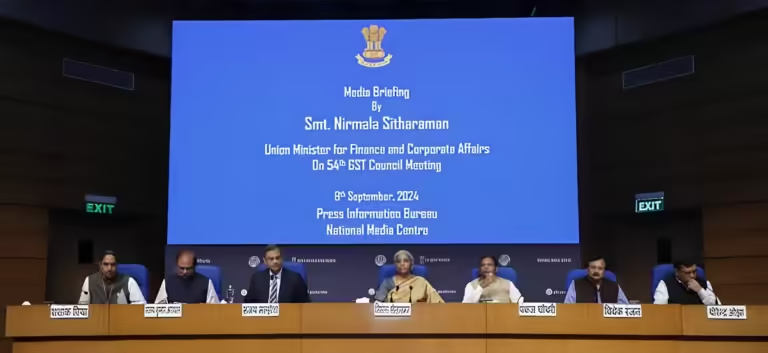
Detailed Summary of Recommendations from the 54th GST Council Meeting
Detailed Summary of Recommendations from the 54th GST Council Meeting Home Insights Detailed Summary of Recommendations from the 54th GST Council Meeting Services Business Incorporation

Ford India Private Limited vs. Deputy Commissioner (ST-III) – Madras High Court Judgment (24 June 2024)
Ford India Private Limited vs. Deputy Commissioner (ST-III) – Madras High Court Judgment (24 June 2024) Home Insights Ford India Private Limited vs. Deputy Commissioner
Standard Chartered Bank vs. The Principal Commissioner Of Central Tax & Others – Telangana High Court Judgment (11 July 2024)
Standard Chartered Bank vs. The Principal Commissioner Of Central Tax & Others – Telangana High Court Judgment (11 July 2024) Home Insights Standard Chartered Bank